After the Black Gold revisited – event
Via Francigena Arts Trail
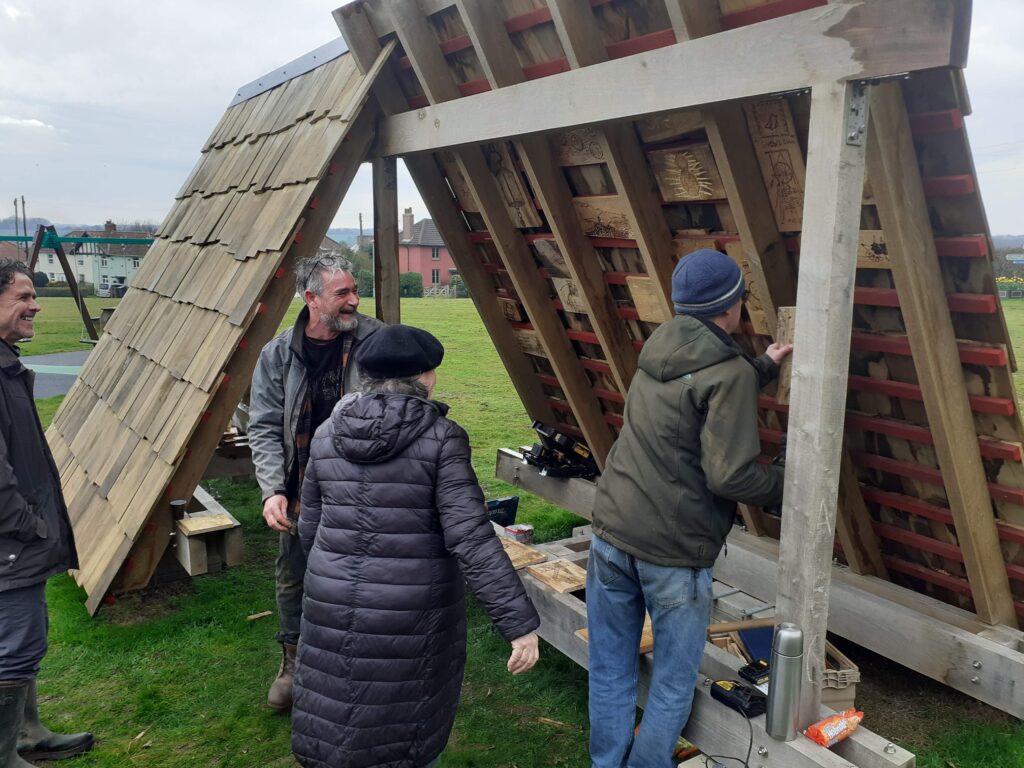
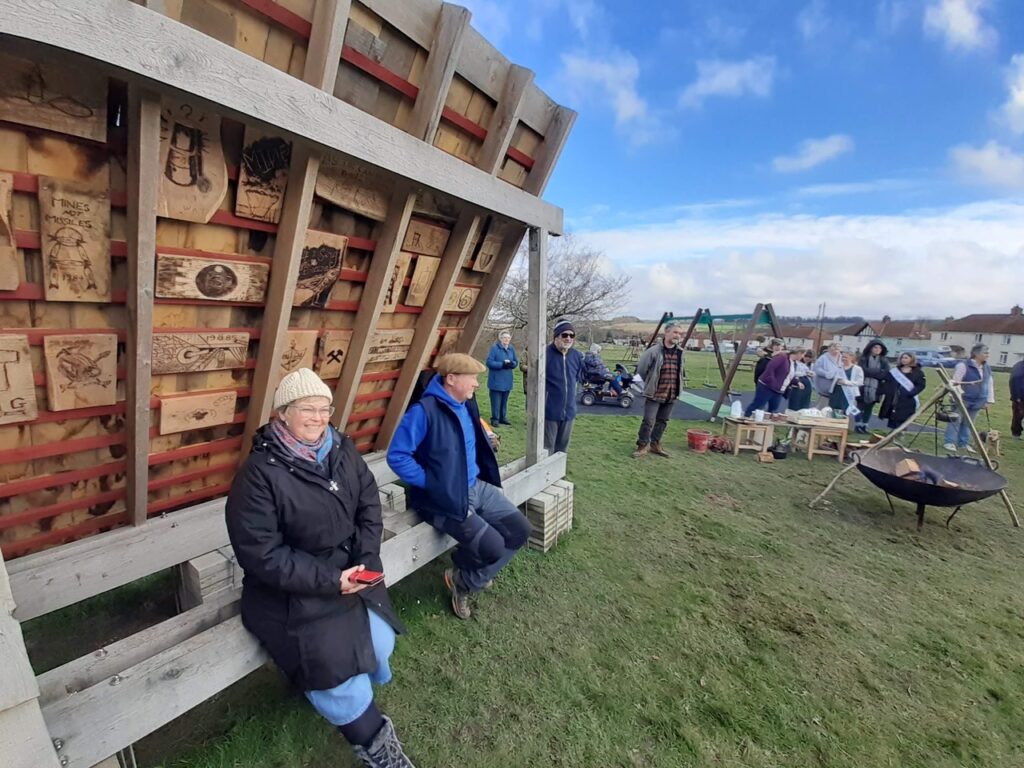
On Saturday the 18th of March 2023 a drizzly morning gave way at almost exactly 2PM to pleasant sunshine, perfectly timed for this happy event at Woolage Village recreation ground – a celebration of the renewal of a work of art. First launched in 2021, this sculpture by Ryan Cook and Sam Little, who worked together as Channel, is a beguiling structure something like a roof without a building – a shelter formed of two large tilted and tiled planes facing outwards, either side of a chunky timber frame. Cormac Martin (of Silverback) had already replaced the original slate tiles with locally sourced chestnut shingles (the slate had got damaged), and on the day before the event he returned with Joanna Jones and Simon Bill of DAD to install 46 more tiles using the undersides of the structure as a gallery wall. These branded and carved art works were created by local people in two workshop events, emblazoned with various motifs and texts relating to the mines, mining and miners. This unorthodox, and wholly successful, use of the work as vehicle for other works had always been a part of the work’s conception. The installation had gone auspiciously well. Each decision about which piece to put where seemed almost to make itself, under Joanna’s curatorial eye.
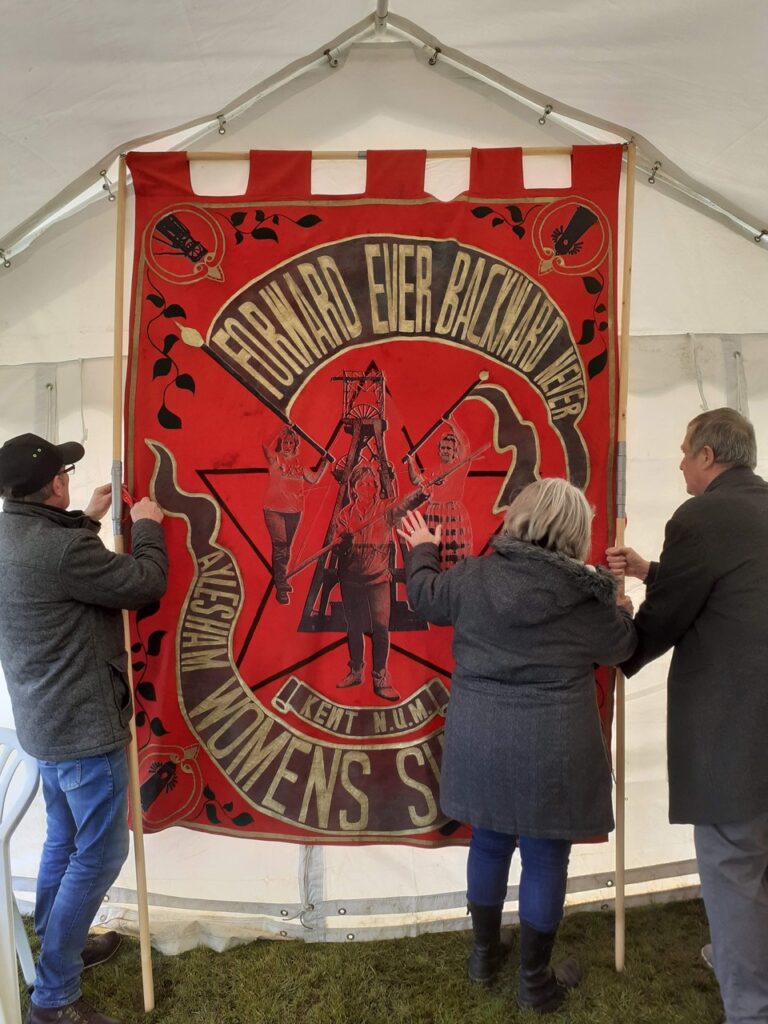
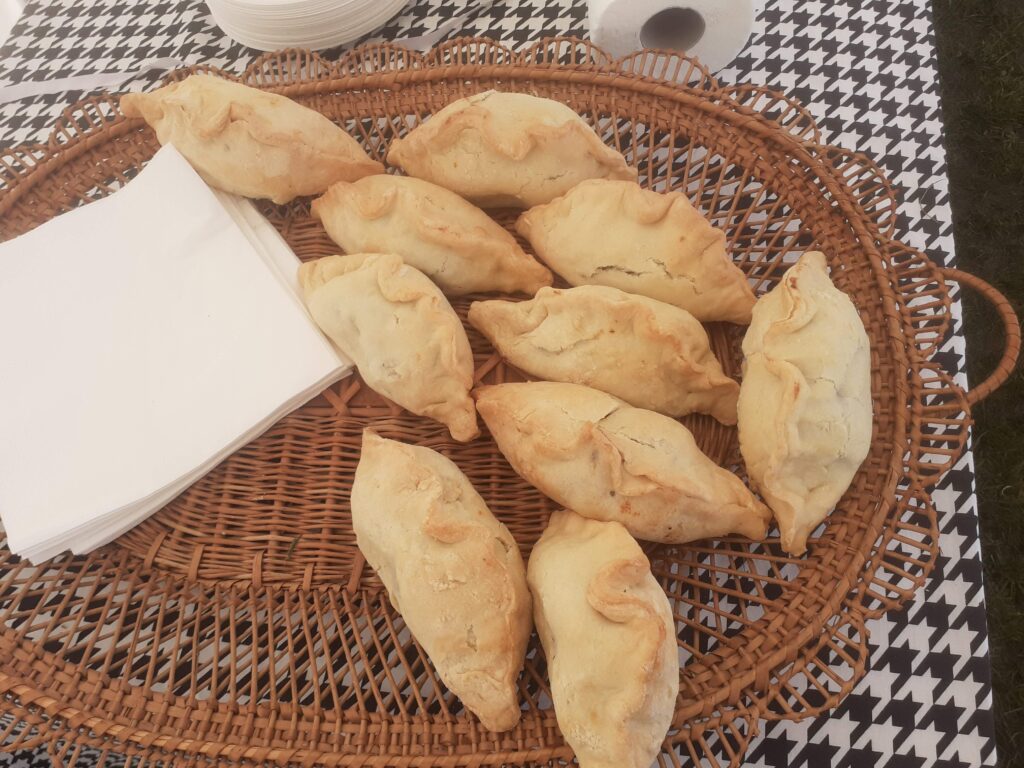
Ahead of the event the scene was set by a team of great blokes from Woolage Village Residents Association putting up a large, festive looking, white tent (onlookers were put in mind of Amish community barn-building). This marquee was a wise (but thankfully unnecessary) precaution against heavy rain, and a place for the tables laden with some extremely local refreshments – sharp Kentish apple juice (one of very many contributions from tireless organiser Charlotte Chapman), and ‘pit pasties’ made with the crumbliest pastry by Lynne Devine. It served, too, as a gallery for the display of two magnificent banners. The oldest (about one hundred years we gather) is the Snowdown colliery NUM banner; the other, which dates from the 1984 miner’s strike, is the banner for the Women’s Support Group, and depicts three women defiantly waving their flags beneath the legend ‘Forward Ever, Backward Never’. And it was Kay Sutcliffe, one of those women on the banner, who actually hung that very banner for display that afternoon; a gesture of significant trust. This is an object of great personal and social/historical value, and is generally kept safely stored away. It was a privilege to see it.
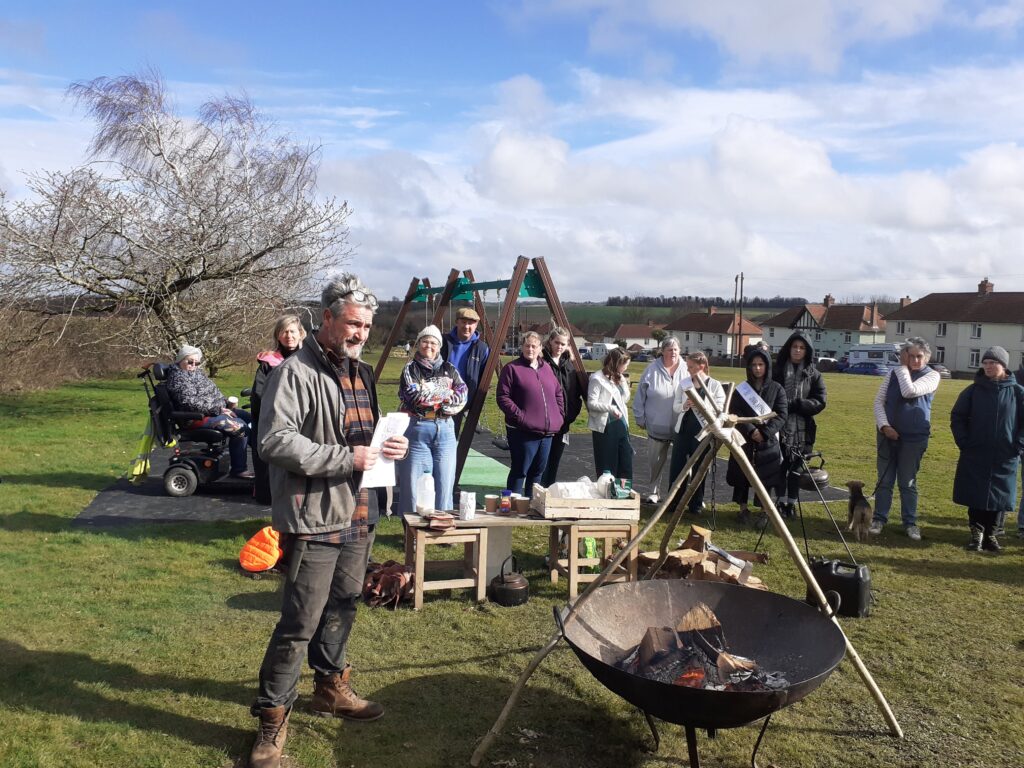
Outside on the grass between the sculpture and the swings was Cormac’s broad, dish-shaped, iron brazier burning chestnut and oak, the offcuts and extras from the creative workshops. The turnout at 2 o’clock was substantial, and included many key figures in the life of this former mining community, their children and grandchildren (instantly making use of those swings). The principal content of the event was a number of brief, very moving, speeches. Kay began with an expression of condolence for the family of Sam Little (Sam died suddenly, not long after this work’s completion, aged 21). She went on to speak of the origins of this community, beginning between the wars as a heterogenous mustering of miners and their families from coal fields all over the UK, the North East, Wales, Scotland, Yorkshire, the Forest of Dean, brought there to work this new coal field in Kent. She spoke of the bonds forged in hard times, and of the continuing value of the sense of community this sculpture is there to represent. In years to come it will be viewed by thousands of walkers travelling the North Downs Way.
Phillip Sutcliffe (Kay’s husband) then gave us a brief memoir, speaking poetically of the pursuits of his childhood in the beautiful Kent countryside, the woods and fields, the yellowhammers and skylarks. This prelapsarian idyll contrasted markedly with the tough and dangerous life of his adulthood as a Kent coal miner. He spoke of his pride, setting out, aged about twenty, as a working man on a full wage, a husband and homeowner (and there is some poignancy in noting that it was at just this age that Sam Little’s life ended). He concluded (following the caveat that he had better not get ‘too political’) by sharing a sad thought – He had believed that he and his comrades were building a better life for those to come, and he deeply mourns the loss of that vision of hope.
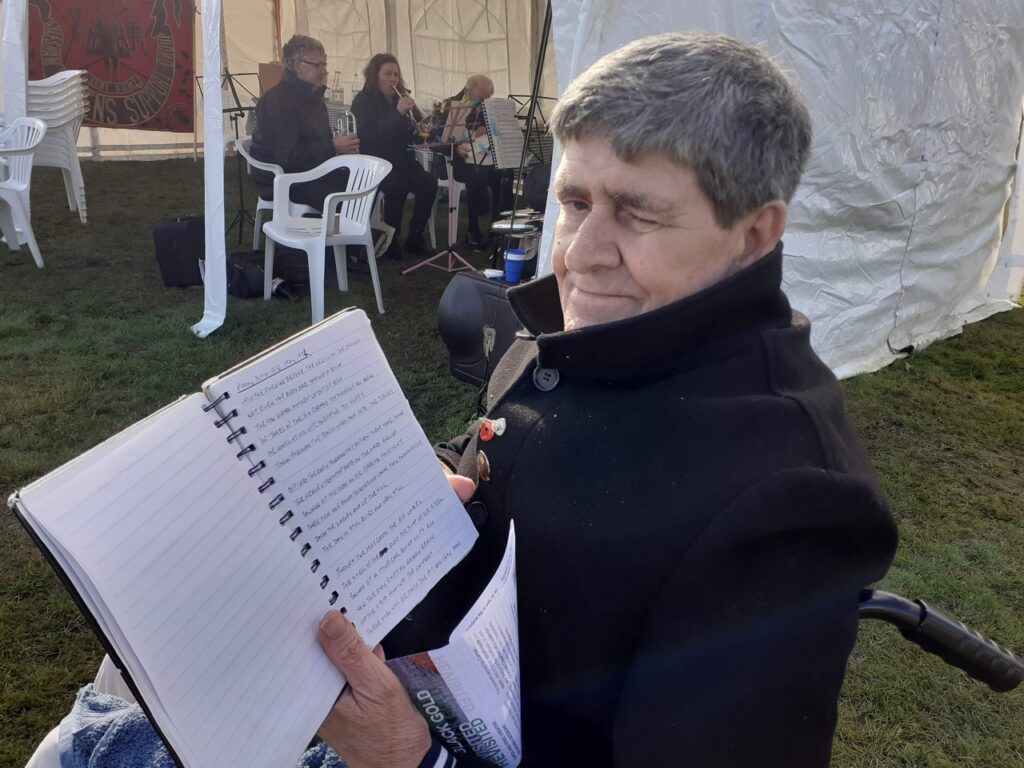
Phillip’s brother Paddy, who in his early twenties had been the youngest shop steward in the country, read a poem from his own hand-written text:
Up in the morning before the dew is on the ground
Not even the birds are making a sound
The man drags himself out of bed
He takes off the sideboard two slices of dry bread
He looks at his wife sleeping so sweet
Then through the back yard and onto the street
The poem goes on to describe the daily ordeal of life in the coal mine, the feat of sheer endurance to be faced every day. (Later he described the poem’s creation, waking in the small hours one morning in 1972, and beginning to compose the piece in a sort of revery, completing the work in one sitting.) Created so long ago, it had become an absolutely fitting contribution, read aloud for the first time ever before the community and its supporters, whilst seated between the house he was born in and the colliery that occupied his entire working life.
There were speeches too by members of the team behind this project, Joanna Jones of DAD, Peter Morris of North Downs, and the redoubtable, multi-skilled Cormac Martin, who read aloud some words from the architect/designer Ryan Cook, then added some inspired and inspiring words of his own.
There was a touching contribution from the ‘Aylesham Queens and Princesses’, this community’s own aristocracy – four local schoolgirls in satin sashes bearing their regal titles, who read a text between them and then performed a simple, incredibly touching, ceremony of gestures.
The remainder of the event, eating ‘pit pasties’, drinking tea and apple juice around the brazier, chatting and laughing as the children played on the swings, was accompanied by music from the Snowdown Colliery Welfare Band, who played sitting in a circle between the historic colliery banners. The original welcome for this work of public art had been somewhat ‘mixed’ or luke-warm. This event paid tribute to the miners and their families, and now, with this new welcoming, the revivified sculpture stands as the physical symbol of a strengthened bond between the members of this small community, and reaffirms its sense of continuity with a distinctive local history.